Identify the model and axes
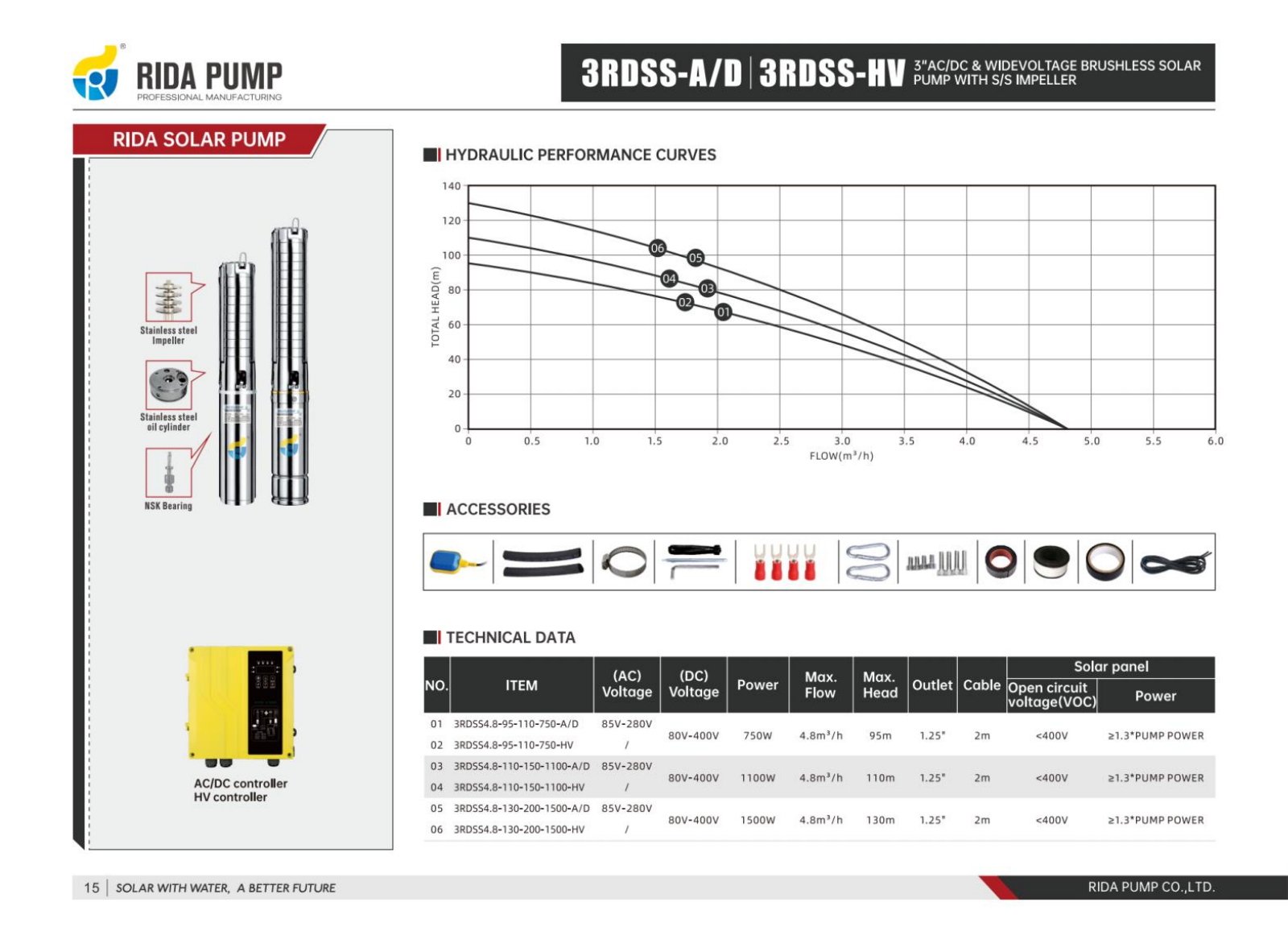
Q represents flow and H represents head. Read the axis units, curve labels and stated operating conditions before comparing values. Use the curve for the exact model shown in the table.
Read flow and head together
Choose a flow value on the horizontal axis, follow it to the relevant curve and read the corresponding head. Maximum flow and maximum head are separate limits, not one operating point. The operating point depends on both the pump curve and the system characteristics.
Use the original RIDA sheet
The reference below is the 3RDSS-A/D and 3RDSS-HV catalogue sheet. Match the curve labels to the model table and keep AC/DC and HV rows distinct. Use the product detail page for the transcribed model references and original documents.
Read the original 3RDSS sheet
 Enlarge the sheet ↗
Keep the duty point with the model
If a project needs 2 m³/h, read the head at 2 m³/h on the exact model curve. A table entry for maximum head cannot answer that question by itself. Check the curve conditions and the system requirement before accepting a model. Keep the AC/DC and HV references on the shared sheet separate when comparing them.
- For centrifugal-pump curves, increasing flow generally reduces the available head at a fixed speed. Check the actual curve rather than estimating between the two maximum values.
- If the required flow and head do not lie within the documented operating range, ask for another model or the missing curve before ordering.
Documents & references
RIDA documents contain product information; external references explain general pump principles.